Category Archives: Stuff People Ask

The Second Screen

tonight

*Photo by Robert S. Donovan: http://www.flickr.com/photos/booleansplit/

How many times have you grabbed your tablet or laptop while watching one of the too many crime shows on television because you wanted to google something you saw to see if it was true? Did you watch the rest of the program with your technology in-hand, your attention vacillating between screens? If  yes, then you’re definitely not alone.

A while ago, television networks figured out that huge portions of viewers watch shows on their television- while using a laptop, tablet or smart phone in one way or another. Viewers had Facebook and Twitter open and sometimes visited program websites. Basically, people are able to consume content from more than one screen at a time. One response was to give shows, even individual episodes their own hashtags encouraging audiences to interact with each other during programming. Some websites began including the supplementary content they thought people would look up on their own anyway.

The great thing about this technology is that it’s mobile. Very few people sit at a desktop while watching television, it’s just not as comfortable as watching our favorite shows from the sofa, recliner or bed. Nearly everybody who’s got a web-enabled mobile device brings it everywhere with them. We’ve also been seeing these devices at lectures, presentations, sporting events, political rallies- you name it- for years now. And as event planners are wising up to harness this technology, we’re seeing the second screen come in to play in all kinds of places.

Have you ever been to a sporting event and had lacked a decent view of the jumbotron or whatever giant(ish) screen the venue used for replays and all the extra facts about a player or the game itself? Frustrating, isn’t it? Wouldn’t it be better if you could just glance at your phone and see what’s going on? Political events aren’t any different. We’ve all listened to someone that we support and have still felt the need to look something up just to make sure they weren’t exaggerating, even just a little. How would you, as part of the voting public feel if a candidate pushed sources from his speech directly to your phone while speaking? Would that increase your trust in them and their causes? It’s better than trying to remember what to look up when you get home, isn’t it?

TEDxHelsinki: audience

*Photo by Mikko Reinikainen: http://www.flickr.com/photos/mtreinik/

This is the second screen. It’s supplementary in so many situations.

2013 brought about a huge adoption of BYOD (Bring Your Own Device) in the workplace and at events. People prefer to use the technology they’re familiar with. Thus far, predictions are pointing toward increased use of audience devices to get people engaged during events in 2014. Unfettered access to wifi and charging stations have already become mandatory at any noteworthy event, because nothing’s worse than trying to work with substandard wifi or panicking over nearly dead devices then fighting with a perfectly nice stranger who needs the same outlet you do for exactly the same reason.

The way we experience events (even remotely) will change as planners think ahead and encourage us to engage online- realtime. Really, there are only two ways to engage users on their own devices. Planners and presenters can enable them via web browsers on devices or using apps. A differentiator in which will succeed and which won’t is the ease of getting connected. Few people will jump through hoops to get connected- even during an event.

As a second-screen app, SlideKlowd approaches this a few different ways.

First, if the event required registration and the event planners know their audience’s email addresses, they can simply upload all of them into the platform (with minimal effort) and send every attendee on their list an invitation. Using this, any participant can get content sent to their “second screen” with just one click.

Screen Shot 2013-12-31 at 10.52.24 AM

Otherwise, participants can join a presentation by going to join.slideklowd.com, logging in and using the Klowd Key that was created by the presenter or event planners. It’s that easy. Event planners have other options to make sure the right people are joining presentations by making them invite-only or filtering by participant email domain (@yourcompany.com, for instance). SlideKlowd offers a number of features to compliment the second-screen nature of the platform, too. Because as event planners are still learning, engagement is more than offering more content- it’s also hearing what your audience has to say.

Passive Listening Isn’t Actually a Thing

Workshop

Some of us talk back to the television. We must. We can’t simply sit still to take in the action and dialogue, but we have to share our opinions, express our outrage and vocalize all of the joy we find in whatever program or movie we’re watching. If we find ourselves not in front of a screen, but instead listening to some sort of speech or presentation, we might still insist on sharing commentary with anyone nearby who’d listen. But, not everybody is like that.

Some viewers are content to sit back and let the plot of whatever sitcom or romcom happens to be on wash over them. Some geniuses were paid to write this stuff, right? What could I possibly contribute to the story? Maybe this is fine, but that same kind of passive consumption has made its way into our workshops, classes, conferences and meetings.

Placid consumerism doesn’t belong in any kind of an educational environment. The notion of an audience quietly sitting, eating up every little thing some guru at the front of the room says seems natural enough to many of us, but that’s only because from childhood, most of us have been (unhelpfully) trained to not interrupt our teachers. We’ve been told that we can ask questions near the end of or after class. Work might be just as bad- nobody wants to speak over their supervisor or the company CEO, right?  Well, even if the smartest man in the world is speaking, simply sitting there listening to him is much less educational than you’d think. Benjamin Franklin said,

Tell me and I forget.
Teach me and I remember.
Involve me and I learn.

If you’re a teacher, trainer, coach or have any involvement in educating people at all, you want them to learn. Rote memorization might help an individual pass a test or get licensure, but when your pupil has to do something, they’ll likely need more than facts. They’ll need an understanding that is incredibly difficult to attain by listening alone.

So what do you do? You invite people to make comments. Ask questions. To actively engage the subject at hand, because that helps them think about it and understand it. Maybe talking back to the television is weird (it totally is) but the people who do it are engaging both characters and plot and they have a more impactful experience than the person who stays quiet the entire time. SlideKlowd helps you bring that out in your classes and audiences, minus some of the social weirdness.

The SlideKlowd platform provides new avenues for interaction, using a participant’s smart phone, tablet or laptop. Personal devices become the mechanism for not only consuming content, but responding to it as well. SlideKlowd allows users to interact with each other via the Comment Stream, Facebook and Twitter. They also have the ability to ask a presenter questions, which help them get what they need or want out of a presentation. Finally, the presenter can add any of the 11 different interactions in the platform to a slide to gather information from an audience or to increase interaction, attention and therefore retention of the subject.

*Photo by Heinrich-Böll-Stiftung: http://www.flickr.com/photos/boellstiftung/

Less is More

clock“I wish that presentation was longer.”

Said no one. Ever.

Too many meetings, pitches, classes and workshops eat up more time than they really ought to. All of us movers and shakers have stuff that we need to get done. We have industries to disrupt and masterpieces to finish. Then there are naps to be had. And the rest of life that’s waiting outside of the conference room, auditorium or classroom.

So, when it’s your turn to share your vast knowledge of molecular physics, quantum chemistry or celebrity gossip, you have the opportunity to do your audience a favor. Maybe more. We’ve got a couple of insights to help make your presentation succinct but impactful.

Less is more
Probably every person who’s ever presented or taught is guilty of trying to fit too much into whatever amount of time they have. We’re passionate about things and want to share every drop of knowledge we have about a subject. We tell ourselves, “The people need it!” And we want to make sure they understand it all, too. So we stuff too much into a presentation and then either go over on the allotted time or have to cut some really awesome stuff out when people get up and start to leave because they have to get to that next session, class or presentation.

How many points are you trying to make? Keep it at about three. Yeah, that that isn’t very many. But if you want your audience to remember everything you’ve said, you’ll keep it simple.

Focus
Moby Dick is a great story- but a terrible (awful, horrible, annoying) book. Know why? Because Melville thought it was appropriate to write whole chapters about the migrating patterns of sperm whales, crows nests and other stuff that didn’t drive the story. Get rid of the asides that not only distract, but consume valuable time.

People check out when you go off on unhelpful tangents. We have proof. The SlideKlowd platform records and measures engagement using your audience’s smart phones, tablets and laptops. When an audience member connects to your presentation using SlideKlowd, the platform knows when their devices go idle or go elsewhere. Because that’s what we do when we’re bored- we grab our mobile technology and check our email, Facebook and watch funny cat videos.

After you’re done with your presentation, you can look at where audiences were most- and least engaged. Adjust your presentation accordingly and you’ll find that people listen, engage and learn more. Because we think you’re actually really good at this, you can also monitor engagement right from the presenter control panel. If you see the numbers start to drop, maybe you should consider moving on to the next topic, or asking your audience to help you adjust your presentation right then and there.

Adjust
If you have to fill four hours with your knowledge, ask the audience to direct your talking points. That way, they’re not hearing things they already know, but they’re getting new or challenging information. The SlideKlowd platform helps you do this in a number of ways. First, they can ask questions or make comments using their personal technology. As the educator or presenter, you’re free to respond to the good ones and ignore the dumb ones.

If you want to have a little more control over the situation, poll your audience. Ask questions like,

How much do you know about _____?

Does your job require you to know about _____?

Which of the following most interests you?

A) _____

B) _____

C) _____

D) _____

Would you rather I share about  _____ ,  _____ or _____?

The best presenters will ask questions like these throughout their presentations. The SlideKlowd platform even accommodates spur of the moment ideas by enabling a presenter to add an interaction while running a presentation. That way, you can always keep things interesting. It’s kind of like those choose your own adventure novels.

Ted talks are never very long, but so many of them have left lasting impressions on the people who’ve listened to them. So don’t be afraid to go short. But remember, SlideKlowd has all kinds of ways to help you and your audience make the most of the time you have together. 

*Photo by Michael: http://www.flickr.com/photos/29254399@N08/

Useful, Even Enjoyable Panel Discussions

panel

Nearly every large event has a panel discussion at one point or another. When done correctly, panels are a great way for an audience to hear several perspectives or opinions on a topic. A poorly run panel can leave audience members feeling awkward, annoyed and completely disengaged.

 A large company recently used SlideKlowd to help moderate a panel discussion where the audience was invited to participate. The conversation went smoothly, stayed on topic and ended on time without any rushed, closing statements.

One of the first things that helped this to be a successfully interactive discussion was that there wasn’t an audience microphone. Anyone who wanted to participate in the conversation was invited to connect using the SlideKlowd platform on their laptop, tablet or smart phone. This had several benefits.

First, this provided a comfortable way for the individuals who never would have gotten up in front of a large group of people to ask questions and share their comments. Everybody in the audience was easily “heard” from their seat, without having to step out of their comfort zone. In addition to this, the pain of passing a mic from one person to the next, or running it all over an auditorium was completely bypassed. There was no opportunity for a dropped a mic, nor were there any awkward silences as the it was carried from one end of the auditorium to the next.

The lack of an audience microphone also prevented any one person from dominating the conversation. We’ve all seen an excessively curious, angry, confused or opinionated person monopolize a panel conversation for an unhelpful amount of time- to the point that others check out, or become irritated. Providing equal, simultaneous opportunity to contribute to the conversation allowed everyone to enter into the dialogue.

While only the moderator could see questions, everybody could see the comments. In this particular event, the audience actually used the Comment Stream to further the conversation among themselves. Some viewers added tidbits of information to supplement what panel members said while others shared their opinions.  If any of the audience members felt like the Comment Stream was distracting, they either ignored it by leaving the Comment Stream closed on their devices, or turning it off entirely.

The SlideKlowd platform also made the moderator’s role easier. He was able to scan through questions and comments while the panel discussed another subject. That way, he was able to filter through questions and comments that were off-topic or too controversial and present the panel with something appropriate when they were ready for it. The moderator looked great because the conversation was easy and seamless.

As he presented the panel with new questions, he also displayed them on the third screen for everyone in the auditorium to see.  This increased visibility and operated as a reminder of the original question while others cropped up and while the panel elaborated on their responses. The SlideKlowd platform doesn’t only make a presentation and the conversation more visible, but it also records all of these interactions.

Informal content- every question, comment, tweet and Facebook post that takes place during a presentation is recorded in the SlideKlowd platform. Presenters who have to respond to questions and comments aren’t going to remember each and every single one of them on their own. The likeliness of having a person around to record all of them is also minimal. SlideKlowd’s analytics are a great way for a panel or moderator to revisit a conversation and see what an audience really cared about. Responsive communicators will then rework their presentation or the conversation to cover the topics that audiences care about most.

 SlideKlowd solves many of the problems that panels have dealt with for years. It encourages and enables audience participation, but helps the moderator retain control of the situation. Random or off-topic questions and comments are easily passed over while useful commentary and questions can be brought to light more easily. Without measurement, improvement is basically impossible. SlideKlowd’s analytics help presenters and moderators to see when audiences were most or least engaged. It retains all of the audience-generated content, which in-turn can be used to improve presentations. SlideKlowd makes attending panel discussions worth the time.

*Photo by Tyler Hoff: http://www.flickr.com/photos/tylerhoff/

What About the Zeroth Rule of Presentations?

Too often, professionals don’t think about some of the most basic necessities of a presentation. Like… whether or not everybody in your venue will be able to see the screen. This leads to small or awkward fonts, busy backgrounds that camouflage text and the problem that S. M. Ali Eslami addresses in his article, The Zeroth Rule of Presentations.

He was attending a conference and encountered a problem that most of us have experienced in poorly designed lecture halls and even movie theaters. There were people in front of him. Some of them may or may not have been giants or had huge heads, which obstructed his ability to see everything that was on the screen at the front of the room.

blocked preso

(Photo credit: S. M. Ali Eslami)

Eslami noted that he was able to sit up straight and lean one direction or another in order to see the blocked information, but that he wasn’t likely to keep that up for an entire presentation. His solution? Put all the important stuff at the top of your slide, followed by secondary information.

His suggestion is admirable- put function above all else, for the sake of your audience. The name of this idea, The Zeroth Rule is either a nod to science fiction written in 1942 or some crazy principle from thermodynamics. We really hope it’s the former, because killer robots are much more fun than heating and cooling.

With SlideKlowd, this isn’t even a concern. Or, it’s less of a concern because the SlideKlowd platform gets your audience up close and personal with your presentation. That second screen in the palm of their hands couldn’t be blocked by the tallest man in the world- unless he was being a jerk.

SlideKlowd connects your audience to your presentation using their smart phones, tablets or laptops- the stuff they’re carrying around with them anyway. All they need is access to wifi. The benefits? You get to use all the space on your slide as you see fit. Eslami’s suggestion is great, but it also provides ample opportunity for ugly slides and wasted space. Your employees, students or audience deserve better than that. Some of them might even demand better. We like those people.

There are other benefits- viewers or participants have the ability to save your presentation (along with any notes they took) to review it all later. If you’re really about instructing or training people, this is fantastic- and doesn’t even require the effort of emailing your slides to everybody.

Audiences can connect from anywhere. We think this is the best solution for a traditional conference, but it’s also killer at teleconferencing. Share your content and communicate with people all over the place using the SlideKlowd platform. You’ll just need to connect using your favorite audio conferencing service.

You took the time to design slides and show off all that super awesome knowledge that you have. The last thing you want is some conference participant sharing a blurry, washed out photo of it with the rest of the world. The platform’s social integration features take care of that. Viewers have the ability to share individual slides from your presentation on both Twitter and Facebook without being left at the mercy of their photography skills, poor lighting or the quality of the camera on their phone.

We think that Eslami’s advice is perfect- do what you need to in order to convey as much information to your audience as possible. They paid for it, didn’t they? We’d encourage you to use SlideKlowd though, instead of cramming everything into the top half of each slide- because frankly, that’s a little weird. Place your presentation and information in your audience’s hands- there, it’ll help you speak/teach/present/train and it will help them to see what’s going on- even if there’s a super tall person sitting in front of them. 

The Big Data You Need

Big Data is one of those phrases that in spite of its ubiquitous application, isn’t understood incredibly well. But basically any time you make a purchase (especially online), you not only contribute to big data, but chances are, you were impacted by it as well.

PayPal has been processing more than five million transactions every single day for years now. That sounds crazy, but other retailers are just as busy. Amazon, Ebay, Target- you name it and they’re processing huge numbers of sales each day- and they’re paying attention to what everybody is buying. Not long ago, this information was difficult to dig into and understand, but that’s not a problem anymore.

Big data is just what it sounds like. It’s looking at each and every transaction that takes place and looking for trends. Then, it’s used to predict future trends and markets. You probably see it when you buy and item and a website suggests that you might like this other, shiny new thing. Chances are when that happens, that you really might like the suggestion.

SlideKlowd jumps into the world of Big Data where others haven’t been able to before. Measuring attention and engagement has been difficult in the past (let’s be honest- it was basically impossible or really, really expensive), but with everyone bringing their smart phones, tablets and laptops into a presentation, class, or training session, it’s become easier to track.

We measure audience engagement by asking them to connect to a presentation using their personal technology- you know, the things that they bring anyway and play on when they get bored? That stuff. You, the presenter get to connect with them via questions, comments and any of the various interactions built into the SlideKlowd platform. But while that’s happening, we can tell you if somebody cut out and where, too.

Big Data is pointless until it’s examined and put to work. Our analytics include every completed interaction as well as those that were ignored by users. They also include what slide each and every viewer joined on, when they exited the presentation and every instance where they left in between. As a trainer, teacher or presenter of any sort, you get the chance to examine what could have caused a third of your audience to disengage at a certain part of your presentation. Were you too controversial? Boring? Did you spend too much time on a slide? Were you monologuing again? Any of these becomes visible as you drill down into the numbers.

Amazon and some of the other giants use big data to drive sales. Customers benefit from it because of a great suggestion based on other purchases- think of that awesome band that Pandora recommended after you liked that song by Kanye. By the way, they’re in town in a few weeks, you need to go buy tickets. Right now. SlideKlowd helps you see what’s working and what isn’t and helps you the teacher/presenter/trainer improve so you can keep peoples’ attention better and make sure that everyone is getting exactly what they need from your presentation.

Screen Shot 2013-11-07 at 1.53.21 PM

Designing for Interaction

A lot of people and organizations are pushing for better design in presentations. They have been for years. Because design isn’t an afterthought, but a necessity if you want to have any kind of an impact at all. But it isn’t simply about looking good. In fact, really great design has function in mind, too. Think about your phone; if it looked really awesome but couldn’t make calls or text people with ease, you’d kick it to the curb.

These are the terms in which you need to consider your presentation. So, as much as we could (and should) go on about things like selecting fonts, images and colors or using the nine-zone grid, we won’t. Because there are other things to think about, too. Like how to make a slide that fits with an interaction.

If you’ve got a presentation that you’ve been using for a while and you’re comfortable with it, the good news is that you don’t necessarily have to change anything. The interactions on the SlideKlowd platform fit into your presentation where you’d normally ask your classroom or audience to respond anyway. But you might want to start collecting data where you hadn’t in the past, but you need to make sure your graphics tell your audience what you want or need from them.

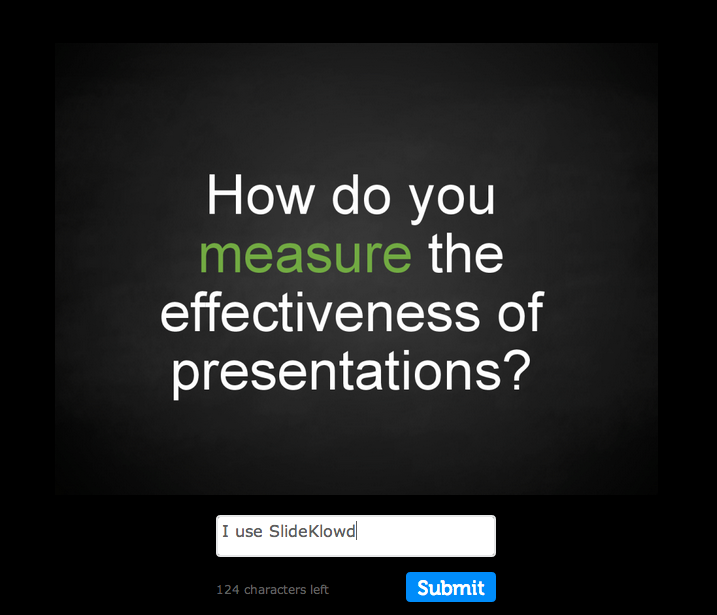
We love asking people about how they’ve measured the results their presentations in the past. We’ve found that very few have had any meaningful way to know if they influenced their audience or not. But, an open question like that utilizes our new Text Response, wherein viewers can respond in 140 characters or less.

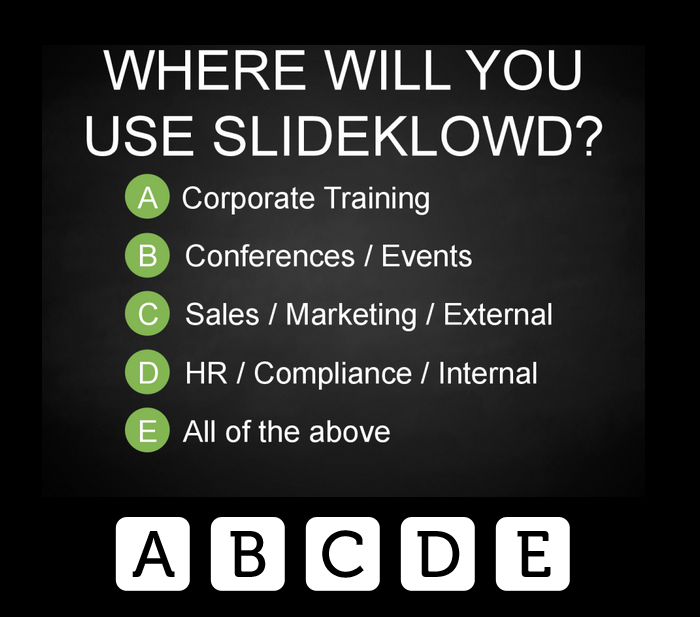
Screen Shot 2013-10-31 at 10.04.02 AMYou wouldn’t want any other interaction (we have 11, total) for a question like this. The SlideKlowd platform also supports multiple choice polling ranging from two to five options per question. One small, but obvious change would be to change numbered lists to fit the A-D format we’ve chosen. Hint: this is also a fantastic replacement for those obnoxious scantron tests that have plagued both students and teachers for years now.

Screen Shot 2013-10-31 at 10.04.34 AM

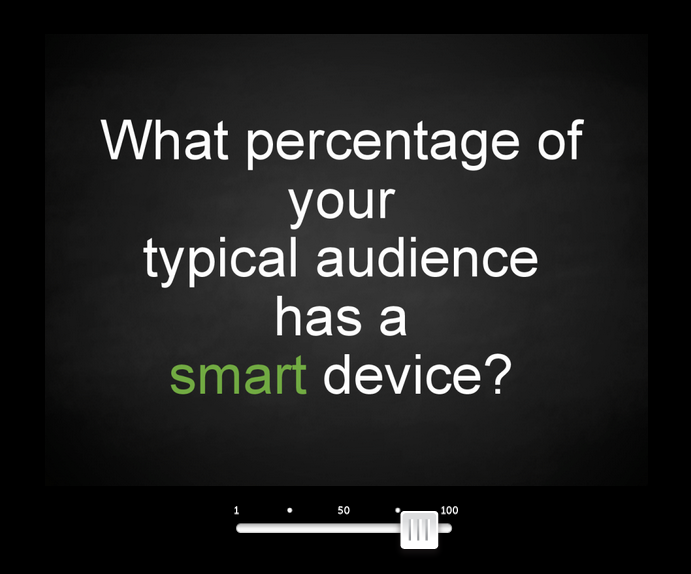
To discover a general feel of an audience or poll them on their approval, an EQ rating is the best approach to take. The platform has three choices: 1-5, 1-10, or if you’re hunting for a percent, 1-100. Each has all kinds of uses, depending on what you need to know.

Screen Shot 2013-10-31 at 10.03.19 AM

Designing your presentation to include interactions will always be the best way to go, but audiences and classrooms are dynamic- not static, so you never know if you’ll have to add a poll or survey where you didn’t plan one before. So, even if you have to go against your original design a little, the SlideKlowd platform can help with that, too.

Individuated Learning

Educational theorists have been studying various learning styles since the 1970s (and probably before then, but that’s when this stuff started getting a lot of attention). They’ve been searching for ways to maximize the time and resources that schools and companies devote to eduction and training- because those are huge investments for any kind of organization. Most of these researching, theorizing types would agree that there are three main methods by which individuals take in and learn information: seeing, hearing and and doing.

Screen Shot 2013-10-15 at 11.25.11 AM

Visual learners are thrilled to see graphs, charts, lines, colors and images. They’re the people who’s eyes are glued to the screen while you present. Spatial relationships are also significant. If your screen is too small or too far away, it can be a huge detriment to learning.


Screen Shot 2013-10-15 at 11.25.00 AM

Next, you’ve got the auditory learners. Not only do they retain information better by hearing it, but also by speaking. Many of them read aloud to make sure they get the information they need. Most auditory learners don’t care so much about what your slides look like as much as they care about what you say- and how you say it.


Screen Shot 2013-10-15 at 11.25.25 AM

The third group is kinesthetic learners. People who learn this way have struggled the most in the past with traditional classrooms. They want to get their hands dirty and would rather be showed how to do something than told.

As a teacher, trainer or speaker, you’ll have all three of these learning styles in every single group you connect with. And it’s on you as the expert in the room to make sure they get the information you have. Daunting? It could be, but you’ve got great tools to work with.

SlideKlowd helps you individuate your learning by making your lessons, presentation or speech more interactive. The platform pushes your presentation to a projector screen and to nearly any of the web-enabled devices that your audience will have with them. This gets your awesomely designed PowerPoint slides up close and personal with your visual learners. They’ll love you for it and the proof will show in how well they retain your information.

Auditory learners benefit, too. Let’s start with a little secret– auditory learners hate when instructors turn away from them to write on a whiteboard. It stifles your voice and kills body language, forcing them to work harder. With a presentation that you navigate using your smart phone, you’re free to fully engage those who care the most about what you say and how you say it. Another benefit is that because most auditory learners don’t take notes, they can save your presentation to review later.

The kinesthetic learners are the people who’d bust their phones and tablets out the minute they get bored, so utilizing what they already have in their hands keeps them engaged. These guys and gals will be thrilled to be able to interact with you, the presenter using their technology. They can also take notes, tweet and post on Facebook about your presentation and keep up with the presentation while they’re at it.

Individuated learning is becoming increasingly significant in classrooms, training centers and elsewhere as educators and CEOs alike understand the necessity for their students or employees to really grasp the material they’ve been given. The smart ones are using what technology has offered them and utilizing what’s showing up, too- people’s smart phones, tablets and laptops.

How do you know that your audience is engaged?

You’ve prepped your audience-and got everyone connected to your SlideKlowd event on their smartphones, tablets or laptops. You’ve got the Event Key displayed on your Third Screen and you’re about to blow their minds. But you wonder, “How will I know if they’re paying attention?”

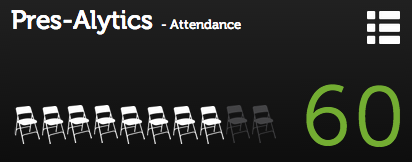
In the Presenter Dashboard, notice the Pres-Alytics (Attendance) area. There you’ll see a row of ten chairs and a green number. The green number is the total number of people have logged into your event.  If you have an audience with web-enabled devices, this should close to the same number of people in your session.

Screen Shot 2013-06-04 at 2.39.33 PM

The chairs indicate what percentage of your attendees are currently engaged. As the image shows, if 80% of the chairs are lit up then 8 of the 10 chairs will be lit up.

Who’s Engaged?

We know what you’re asking: how do we know if a person is or isn’t engaged? It’s not quite magic, but it’s as close as any developers could get.  Every two seconds, we send a “ping” to each device that is logged in. If they are still logged in, then all is well. If not, then after 30 seconds of inactivity by an attendee, it will be reflected in the Pres-Alytics row of chairs.  Note that every disengagement by an attendee is tracked in the analytics.

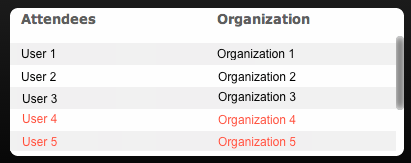
If you want to know who is or is not paying attention, just click or touch the list icon just above the green audience number to see the name of each person who has logged in to your event. If they’ve completed their audience profile, their organization will be displayed as well. Any person whose display name is in black is currently engaged. The names in red have disconnected from the presentation or need to wake their device back up.

engagement

Other Ways to Use Pres-Alytics:

As we described, the Pres-Alytics is a real-time and at-a-glance view of engagement.  What else can you do with this info?

  • You can use it to monitor the over-all engagement level of the session.  If you notice the chairs start to go dark, we suggest that you add some interaction on the fly – or break out your “RiverDance” routine.
  • If you are in a compliance or training-type presentation, you can use the Pres-Alytics to report on participation and engagement level.  Then you can call them out by name and tell them to pay attention!
  • If you are giving a sales or motivational presentation, you can monitor the Pres-Alytics to be sure your call-to-action is at the height of emotion.  If all the chairs are lit up, ask for the deal, the donation or the vote!

After Your Session

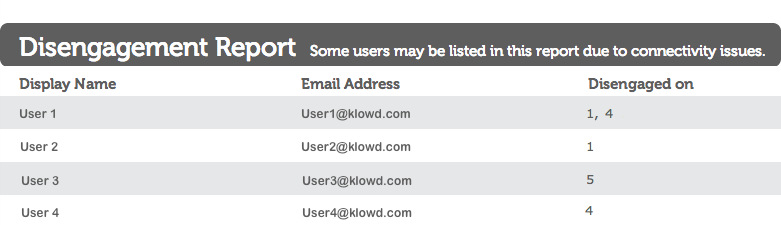
After you’re done presenting, take a look at the disengagement report in the Presentation Analytics to see what slide(s) they disconnected on. Consider your content: your slide, what you said, whether or not you had an interaction. Based on this data you can adjust and improve your next presentation.

Screen Shot 2013-06-05 at 3.17.06 PM

How do you get an audience ready for a SlideKlowd presentation?

It would be totally groovy if all audience members accessed SlideKlowd before the presentation started so that you are not taking time at the beginning of the presentation to get them signed on. Accessing and registering on SlideKlowd, either through a smartphone app or browser, is seriously painless so it just about sending out a few friendly reminders.

You have five reminder opportunities to give them instructions on how to access SlideKlowd.

1. On your event website: Let your guests know that you will be using a cool app to allow them to immediately tell the presenter what they are thinking throughout the presentation. Use this “benefit to the audience” as a way to differentiate your event as hip, innovative and relevant. Just like you!

2. During the registration process: Once a guest has registered, they will receive a confirmation email with the essentials. Go ahead and add instructions to that e-communication on accessing SlideKlowd. Provide the event key, if you want, but it is not necessary at this point. Here’s what we included in an email that went out before one of our CEO’s presentations using SlideKlowd.

BYOD3. E-Reminder: About one week out you will send out another email that says “Hey, if you forgot that you registered for my event, here are the details.” Prominently include SlideKlowd instructions similar to the BYOD box above.

4. Table Decoration: Place a handout at each table setting or on each chair with download and sign-in information. Include the event key. Below is an example of what one of our clients used as their handout. If you need help creating a handout, contact us.

QuickStartGuide

5. Default first slide: If all else fails, you’ve got your initial default slide that pops up before you launch your event that details how to sign in and your event key. This is what it will look like:

1stSlide-Sign-in

If you are still facing a few folks who just refuse to sign-in, rest assured they will want to after they see everyone else participating. You’ll often see the stragglers sign-in right after that first interaction when you ask everyone else their opinion about something important to them.