Tag Archives: interaction

Stop. Collaborate. Listen: Networking at Events

networking

Conversation
Your event has hundreds, maybe thousands of like-minded individuals in attendance. Many showed up for the presenters, while others for the vendors. Regardless of which conference features attracted them, your participants will want to network- to get to know their peers.

Event planners have figured out that the people attending their conferences and conventions want to build relationships with other attendees. They desire to share ideas and learn from their peers. Many planners have responded accordingly, by scheduling networking time and  creating spaces for interaction into their events. Which is really helpful, but more can be done to support event networking and collaboration.

Discussion after a presentation is fine, but what happens when the talk itself becomes interactive? Bring the conversation into the presentation with SlideKlowd. Participants can talk to each other as well as communicate with the presenter using the Comment Stream or questions. Doing this allows audience members to share their own experience or expertise and to connect with someone across the auditorium, instead of trying to chase them down when the speaker is done presenting.

Hybrid Events
Networking becomes a million times more difficult when the event has a combination of live, in-person attendees with a virtual audience. By the way, hybrid events and virtual attendance are on the rise. Face-to-face meetings simply are not an option for anyone who’s joining the presentation remotely. But the same SlideKlowd tools can serve those who are hundreds or thousands of miles away, helping them to connect with the rest of the audience- wherever they happen to be.

SlideKlowd’s integration of Twitter and Facebook brings  the connection outside of the platform as well. Audience members can post to either platform from within SlideKlowd. While creating a presentation, the speaker has the option to create an event hashtag that will be appended to each social media comment that is posted from the platform. They also have the option to include their own Twitter handle or Facebook URL, making sure they’re part of the online conversation. 

We caught a couple of the sessions happening over at PCMA Convening Leaders event over in Boston. We connected to the event online, since we’re all the way over here in Eagle, Idaho. One thing we noticed that stood out the most was that the event provided live video streaming for those of us who didn’t have the time to travel across the country to attend. Anymore, this is a must for any large event. In addition to that though, a simple chat interface was provided that enabled those of us scattered all over the place to offer our commentary and catch up with each other during  sessions. The conversation was nonstop.

Jeff Hurt, whose talk, Avoid the Conference Zombie Zone  was an office favorite. He did the best job at addressing both the in-person audience as well as online participants. He provided time for conversation in the audience between talking points, during which he took a couple of minutes to directly address the virtual attendees. Mr. Hurt had an moderator interacting with the online conversation who also presented him with questions or comments that had come from the chat. In responding, he spoke directly to a camera that was set aside for those of us who’d connected digitally. Then he went back to the crowd and continued his talk.

While Mr. Hurt did an amazing job at including the entire audience, not all of the presenters did this as well. It’s simply easier to address the people sitting right in front of you. Another challenge in this kind of situation is getting both types of participant to converse with each other. The only people who could see the online conversation were those who’d logged in to see the video- which would be redundant for anyone present at the event.

The SlideKlowd platform belongs in hybrid events. With everyone (in-person or miles away) logged into the platform, the conversation escapes the four walls of the auditorium. Inclusion becomes as easy as audiences joining on their smart phone, tablet or laptop.

*Photo by Jeroen Komen: http://www.flickr.com/photos/ikreis/

Useful, Even Enjoyable Panel Discussions

panel

Nearly every large event has a panel discussion at one point or another. When done correctly, panels are a great way for an audience to hear several perspectives or opinions on a topic. A poorly run panel can leave audience members feeling awkward, annoyed and completely disengaged.

 A large company recently used SlideKlowd to help moderate a panel discussion where the audience was invited to participate. The conversation went smoothly, stayed on topic and ended on time without any rushed, closing statements.

One of the first things that helped this to be a successfully interactive discussion was that there wasn’t an audience microphone. Anyone who wanted to participate in the conversation was invited to connect using the SlideKlowd platform on their laptop, tablet or smart phone. This had several benefits.

First, this provided a comfortable way for the individuals who never would have gotten up in front of a large group of people to ask questions and share their comments. Everybody in the audience was easily “heard” from their seat, without having to step out of their comfort zone. In addition to this, the pain of passing a mic from one person to the next, or running it all over an auditorium was completely bypassed. There was no opportunity for a dropped a mic, nor were there any awkward silences as the it was carried from one end of the auditorium to the next.

The lack of an audience microphone also prevented any one person from dominating the conversation. We’ve all seen an excessively curious, angry, confused or opinionated person monopolize a panel conversation for an unhelpful amount of time- to the point that others check out, or become irritated. Providing equal, simultaneous opportunity to contribute to the conversation allowed everyone to enter into the dialogue.

While only the moderator could see questions, everybody could see the comments. In this particular event, the audience actually used the Comment Stream to further the conversation among themselves. Some viewers added tidbits of information to supplement what panel members said while others shared their opinions.  If any of the audience members felt like the Comment Stream was distracting, they either ignored it by leaving the Comment Stream closed on their devices, or turning it off entirely.

The SlideKlowd platform also made the moderator’s role easier. He was able to scan through questions and comments while the panel discussed another subject. That way, he was able to filter through questions and comments that were off-topic or too controversial and present the panel with something appropriate when they were ready for it. The moderator looked great because the conversation was easy and seamless.

As he presented the panel with new questions, he also displayed them on the third screen for everyone in the auditorium to see.  This increased visibility and operated as a reminder of the original question while others cropped up and while the panel elaborated on their responses. The SlideKlowd platform doesn’t only make a presentation and the conversation more visible, but it also records all of these interactions.

Informal content- every question, comment, tweet and Facebook post that takes place during a presentation is recorded in the SlideKlowd platform. Presenters who have to respond to questions and comments aren’t going to remember each and every single one of them on their own. The likeliness of having a person around to record all of them is also minimal. SlideKlowd’s analytics are a great way for a panel or moderator to revisit a conversation and see what an audience really cared about. Responsive communicators will then rework their presentation or the conversation to cover the topics that audiences care about most.

 SlideKlowd solves many of the problems that panels have dealt with for years. It encourages and enables audience participation, but helps the moderator retain control of the situation. Random or off-topic questions and comments are easily passed over while useful commentary and questions can be brought to light more easily. Without measurement, improvement is basically impossible. SlideKlowd’s analytics help presenters and moderators to see when audiences were most or least engaged. It retains all of the audience-generated content, which in-turn can be used to improve presentations. SlideKlowd makes attending panel discussions worth the time.

*Photo by Tyler Hoff: http://www.flickr.com/photos/tylerhoff/

Designing for Interaction

A lot of people and organizations are pushing for better design in presentations. They have been for years. Because design isn’t an afterthought, but a necessity if you want to have any kind of an impact at all. But it isn’t simply about looking good. In fact, really great design has function in mind, too. Think about your phone; if it looked really awesome but couldn’t make calls or text people with ease, you’d kick it to the curb.

These are the terms in which you need to consider your presentation. So, as much as we could (and should) go on about things like selecting fonts, images and colors or using the nine-zone grid, we won’t. Because there are other things to think about, too. Like how to make a slide that fits with an interaction.

If you’ve got a presentation that you’ve been using for a while and you’re comfortable with it, the good news is that you don’t necessarily have to change anything. The interactions on the SlideKlowd platform fit into your presentation where you’d normally ask your classroom or audience to respond anyway. But you might want to start collecting data where you hadn’t in the past, but you need to make sure your graphics tell your audience what you want or need from them.

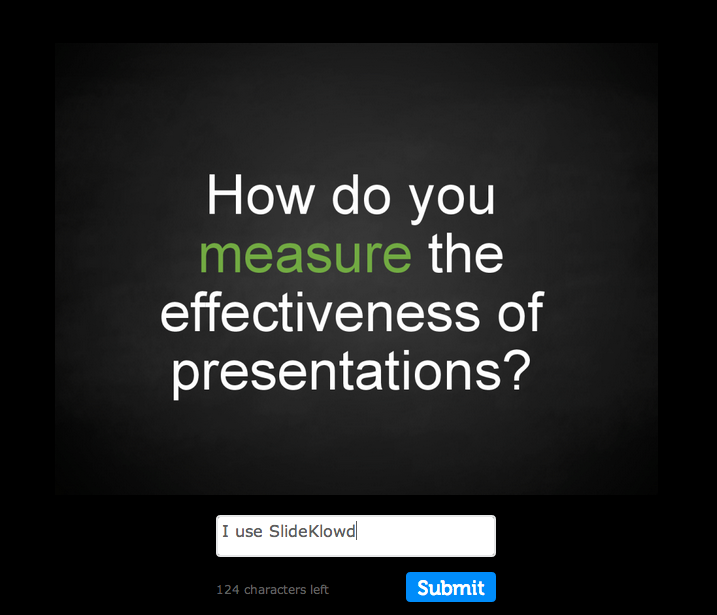
We love asking people about how they’ve measured the results their presentations in the past. We’ve found that very few have had any meaningful way to know if they influenced their audience or not. But, an open question like that utilizes our new Text Response, wherein viewers can respond in 140 characters or less.

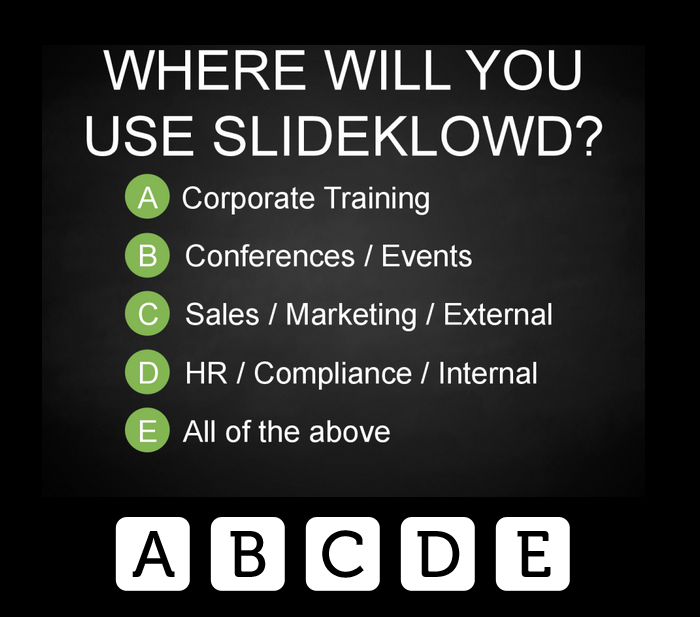
Screen Shot 2013-10-31 at 10.04.02 AMYou wouldn’t want any other interaction (we have 11, total) for a question like this. The SlideKlowd platform also supports multiple choice polling ranging from two to five options per question. One small, but obvious change would be to change numbered lists to fit the A-D format we’ve chosen. Hint: this is also a fantastic replacement for those obnoxious scantron tests that have plagued both students and teachers for years now.

Screen Shot 2013-10-31 at 10.04.34 AM

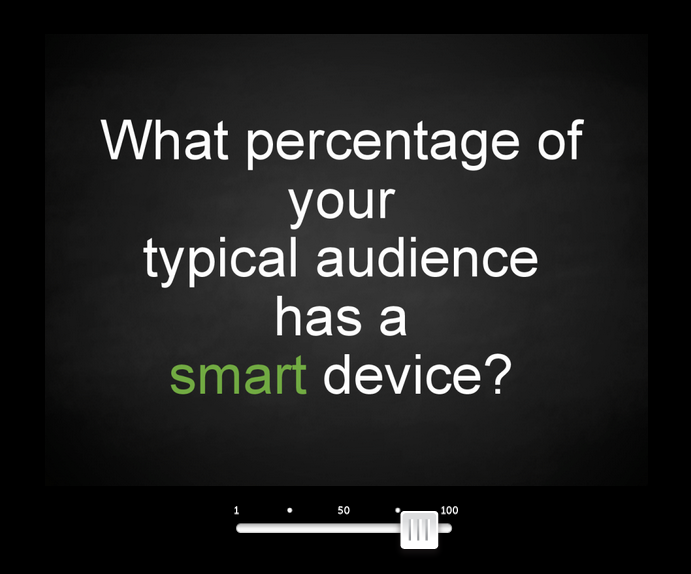
To discover a general feel of an audience or poll them on their approval, an EQ rating is the best approach to take. The platform has three choices: 1-5, 1-10, or if you’re hunting for a percent, 1-100. Each has all kinds of uses, depending on what you need to know.

Screen Shot 2013-10-31 at 10.03.19 AM

Designing your presentation to include interactions will always be the best way to go, but audiences and classrooms are dynamic- not static, so you never know if you’ll have to add a poll or survey where you didn’t plan one before. So, even if you have to go against your original design a little, the SlideKlowd platform can help with that, too.